THEIA II: design and technology
THEIA II is an outdoor GPS smartwatch designed in Geneva by Air’n Outdoor, a Geneva-based company. It is made to be worn on the mountain and in town, so the design had two jobs: give accurate data outdoors, and look like a watch. This page explains what is inside this smartwatch and why: the screen, the GPS, the sensors, the battery and the software. Prices and the full specification table are on the THEIA II page.
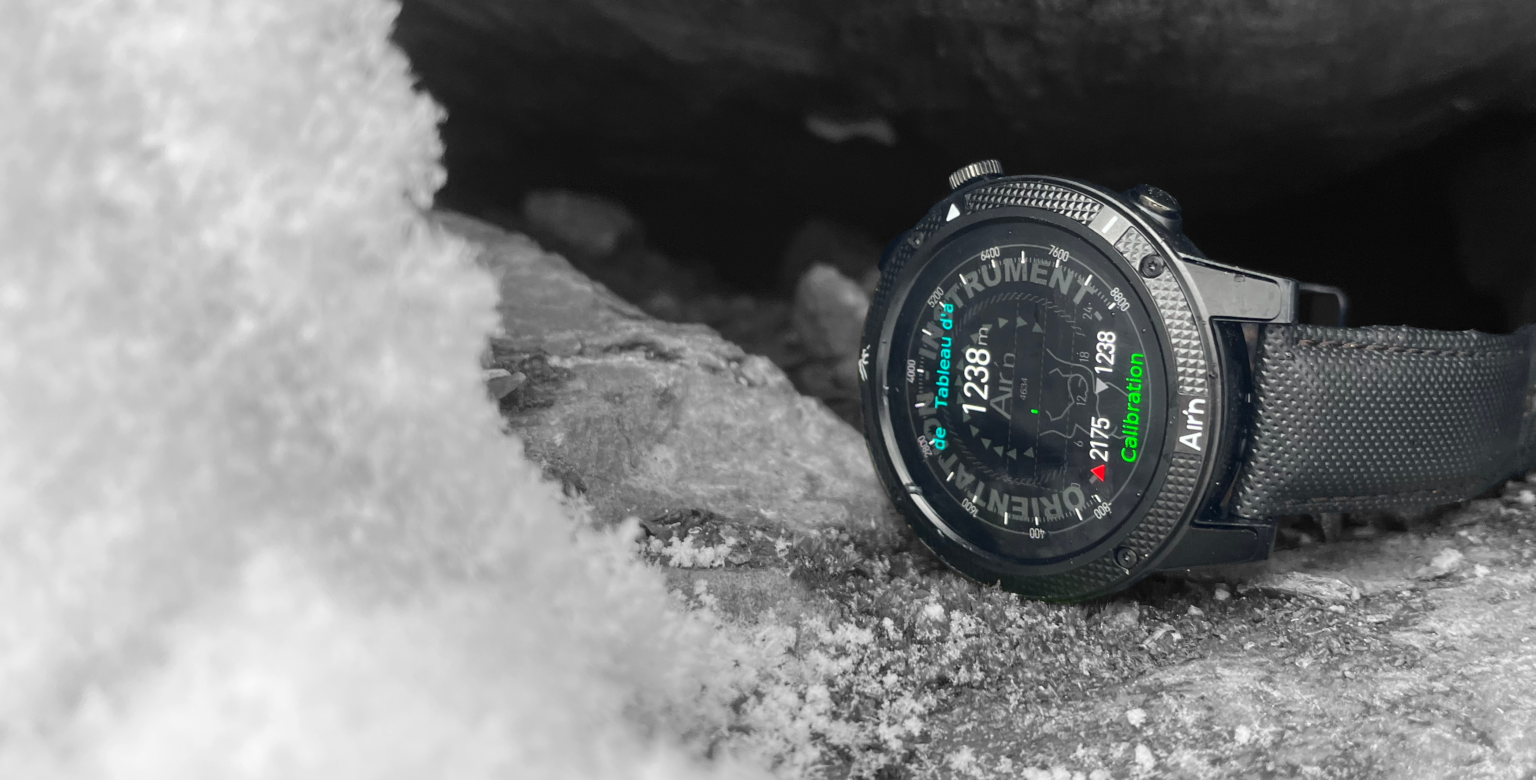
An elegant smartwatch built for the mountains
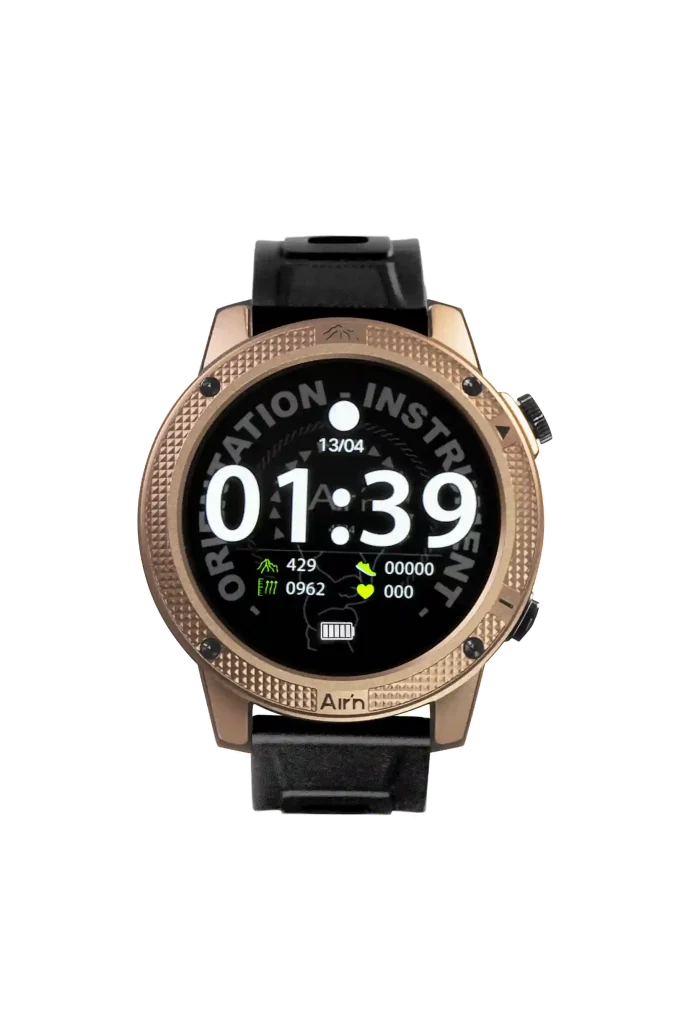
We did not want a smartwatch that looks like a tool. We wanted the advanced features of outdoor GPS watches in a round case with a finished bezel, a strap you can change, and a screen you can read in sun: a smartwatch with the style of a classic watch, for users who prefer one watch from the trail to the office.
- Case:
- round, 49.5 mm across and 15 mm thick, 58 g. It is a large watch, light for its size.
- Bezel:
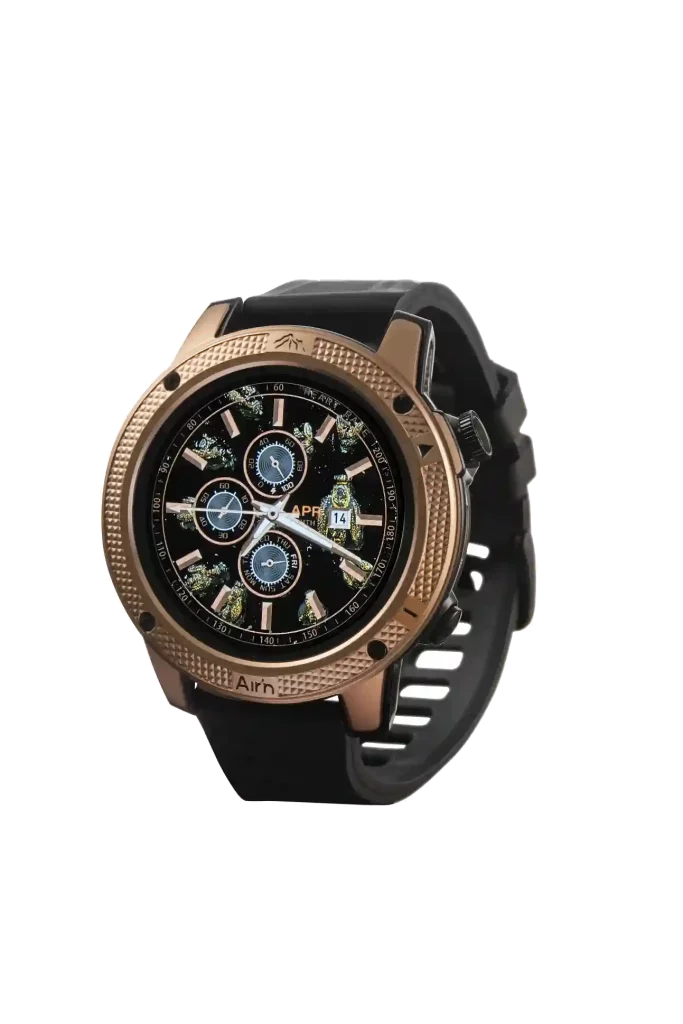
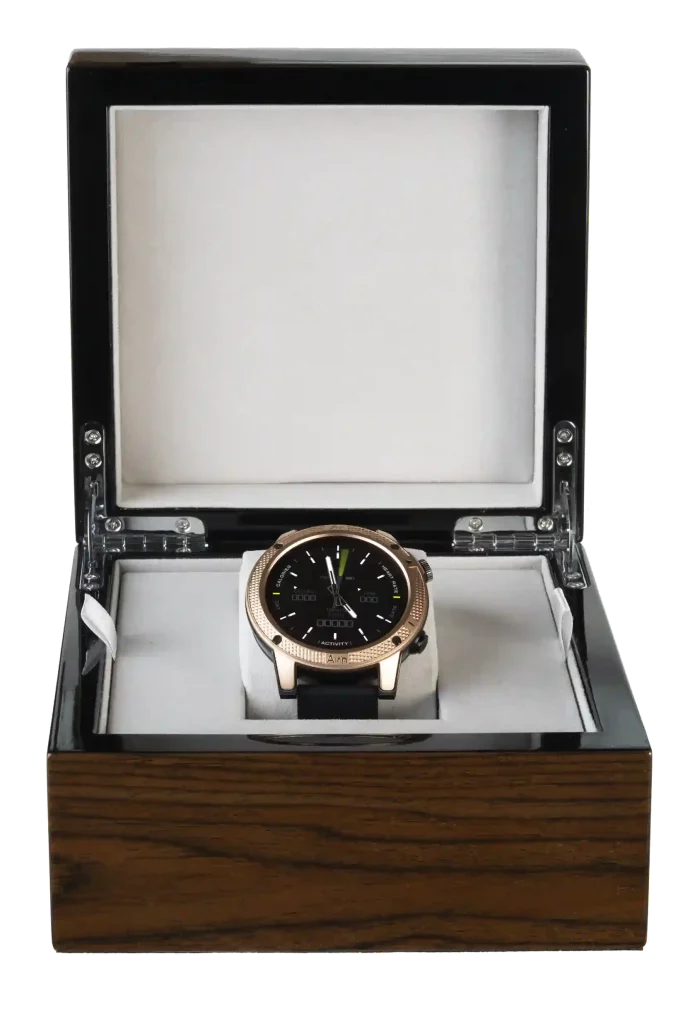
- notched, in three finishes: Absolute Black in black DLC with Luminova icons, White G in white-gold PVD (plated with white gold), Rose G in rose-gold 5N18 PVD (plated with 5N18 rose gold).
- Caseback:
- 304L stainless steel, PVD coated.
- Build quality:
- impact-tested on rock in the Calanques of Marseille with the Compagnie des Guides de Chamonix.
- Straps:
- 22 mm with quick-change bars. Silicone comes in the box. The waterproof leather strap is glued and stitched onto a silicone base, made to match the clou de Paris pattern of the bezel (CHF 70).
- Watch faces:
- seven, for the trail or the office.
The three finishes have the same features. Absolute Black costs CHF 369; White G and Rose G cost CHF 469.

Screen, controls and glass
The screen is a 1.43-inch AMOLED touchscreen at 1,000 nits: bright enough to read in sun and on snow. You control the smartwatch with the touchscreen and a rotating crown. During GPS tracking the touchscreen locks, so rain and spray cannot control it; the bottom button unlocks it.
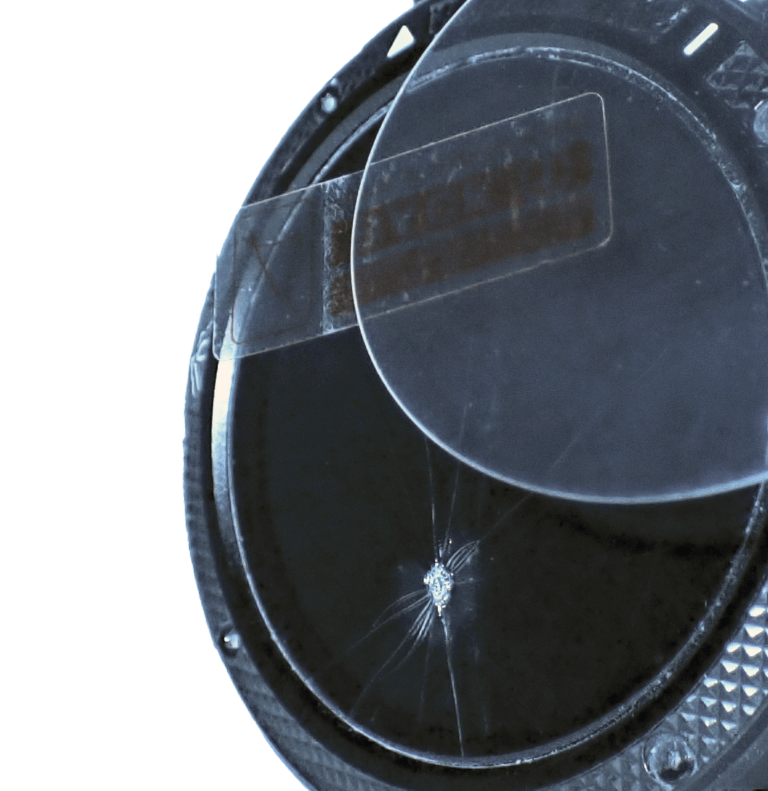
The glass is W-Glass Secure, a layered design: a translucent polymer layer with a layer of mineral glass on top. If the mineral glass breaks, the polymer layer still protects the watch. You have the ability to replace the broken layer yourself, for a small fee, and one replacement comes in the box. The patented concept belongs to Nooze Technologies.
Many premium watches use a sapphire lens, which resists scratches better than mineral glass. A cracked sapphire lens goes back to a watchmaker; W-Glass Secure you change at home. If scratches are your main concern, a sapphire lens is the better choice. If you want to fix the glass yourself on a trip, W-Glass is.
Dual-band GPS, multi-band GPS and GNSS
GPS watches find your location by listening to satellites. GNSS is the name for all satellite navigation systems together: GPS is one, and Galileo, GLONASS and BeiDou are others. A receiver needs signals from at least four satellites to fix a position. A watch that tracks several systems sees more satellites at once, which helps in valleys where part of the sky is hidden. GNSS works anywhere in the world with a view of the sky, with no phone network.
Each system sends signals on more than one frequency band. A single-band receiver uses one of these bands; a dual-band GPS receiver uses two, L1 and L5 for GPS. The second band lets the watch filter out signals that bounce off cliffs, valley walls, trees and buildings, so the position stays accurate in complex terrain where a single band drifts.
What dual-band GPS changes on your track
- In the mountains:fewer jumps in the track along cliffs and in narrow valleys.
- In forest:a steadier position under trees, where a single band loses accuracy.
- In the city:fewer errors between tall buildings, where signals reflect off walls.
- On the map:a recorded distance closer to the distance you really covered.
Multi-band GPS is the wider term: a receiver that uses more than one band, on GPS and other satellites. Dual-band GPS is one form of multi-band GPS. On single-band GPS watches, a track in a narrow valley can zigzag; dual-band GPS reduces that, because the signal quality on two bands is easier to check than on one.
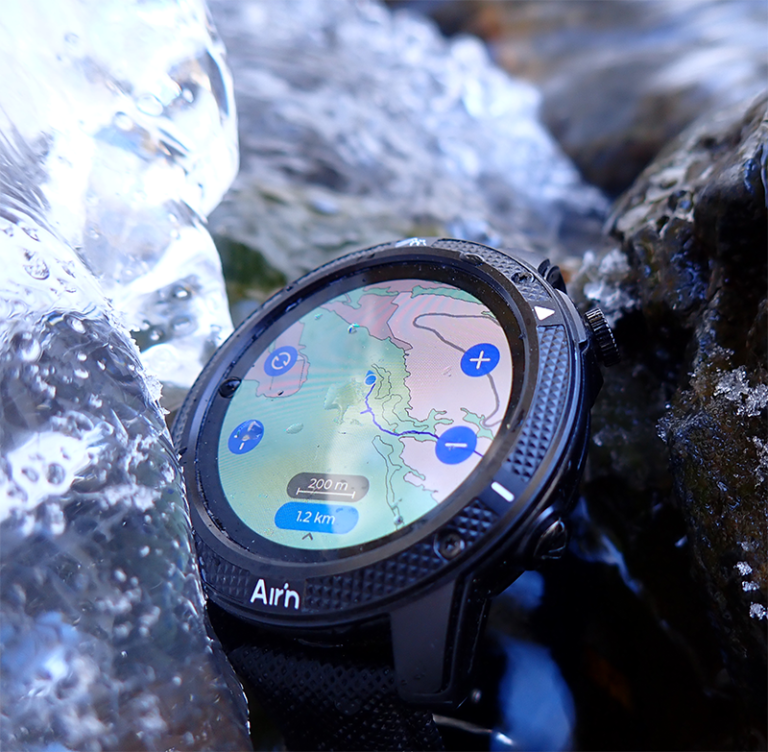
THEIA II has a dual-band GPS module and multi-band GNSS, so its GPS location and the distance it tracks stay accurate in steep and complex terrain. In tests, the team reports that it still allowed navigation about 15 m below the ice of the Mer de Glace near Chamonix, and the tracks it recorded at sea off the Levant Islands closely matched the route on Navionics charts.
Dual-band GPS uses more power than single-band GPS, so it shortens battery life in GPS mode. That is the trade for accuracy and precision in steep terrain, where a wrong position becomes a safety problem.


Heart rate and other sensors
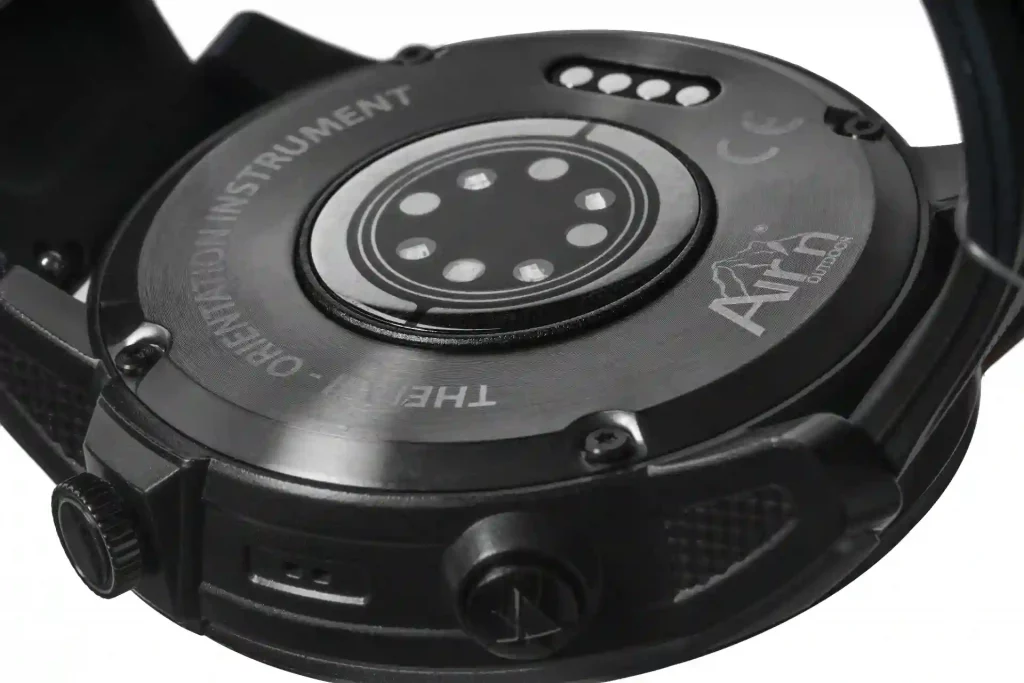
The optical sensors on the caseback handle heart rate monitoring and measure blood oxygen (pulse oximeter). Heart rate monitoring at the wrist works by light: the sensor reads the change in blood flow under the skin. During hard intervals, a chest strap reads heart rate more accurately than any wrist sensor; for hiking, ski touring and daily wear, the wrist sensor is the practical choice. A 3D accelerometer tracks steps and movement. A pressure sensor works as a barometric altimeter and as a barometer, which gives a storm warning when the pressure drops fast. A compass gives your heading, also when you stand still.
The algorithms for sleep, heart rate variability, stress and recovery were developed with the University of Geneva. Air’n Outdoor compared the heart rate, blood oxygen and accelerometer data in a test with the University of Geneva and the EANS Foundation. Your health data and where it is stored are explained on Data and privacy.
Battery life
Battery life depends on usage: the screen, the GPS mode and the sensors all draw power. THEIA II is rated 20 days of battery life in normal use and 15 hours in GPS mode. It has a lithium-ion battery, charged by the USB-A or USB-C cable in the box. That covers a long day in the mountains with GPS tracking on, and a charge every few weeks in daily life.
Long battery life over several days with GPS on comes from solar charging or a bigger battery, and expedition watches lead there. Life in GPS mode is shorter on every smartwatch, including the best smartwatch for battery life, because the GPS receiver draws extra power. Battery performance also drops in the cold, so keep the watch under your sleeve on winter tours.
Processor, software and app
- Processor:
- 32-bit dual-core, 160 MHz.
- Operating system:
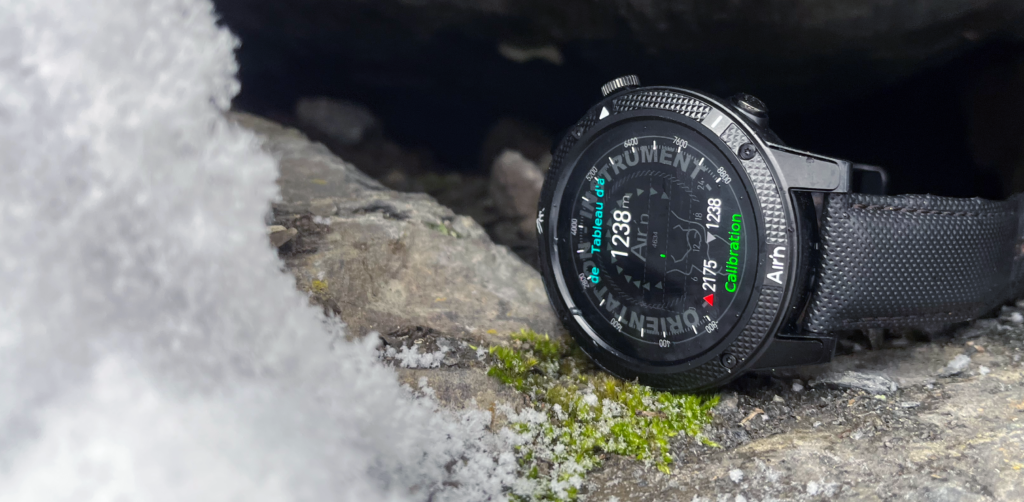
- EIONE, updated through the app. Since EIONE 0.6.4, the watch shows elevation gain in real time with GPS on.
- App:
- AIRN CONNECT for iOS and Android, paired over Bluetooth. Compatible devices: iPhone and Android phones. You plan routes on OpenStreetMap and send them to the watch. Tracks sync to Strava.
- Maps:
- stored in 4 GB of memory, loaded from your computer by USB before you leave. Do not forget to load the maps for your region before a trip.
- Sport modes:
- walking, mountaineering, ski touring, cycling, running, and a distance mode that shows speed in knots for sailing and water sports.
- Everyday:
- message notifications, find my phone, steps, sleep tracking, alarm, stopwatch.
Core functionality works on the watch alone: maps, GPS tracking, return to start, the altimeter, the barometer and the compass. The app and paired devices add route planning, updates and notifications.


Features at a glance
- Navigation features:offline maps in 4 GB, routes from the app, track recording, return to start, real-time elevation gain.
- Safety features:return to start without a phone, SOS through your paired phone, storm warning, screen lock in rain.
- Health features:heart rate monitoring, blood oxygen, sleep tracking, heart rate variability, stress and recovery.
- Smartwatch features:message notifications, find my phone, alarm, stopwatch, seven watch faces.
- Sport features:walking, hiking, mountaineering, ski touring, cycling, running and sailing modes.
Training, running and other activities
THEIA II has sport modes for hiking, mountaineering, ski touring, cycling, running and sailing. In each of these modes it tracks distance, time and heart rate for the workout, and you send the workout to Strava. The running mode covers easy runs and trail running in the mountains; each workout goes to Strava with your other training.
Runners who train with pace targets, intervals and a structured training plan, and who want training load and recovery advice for each workout, get more from a running watch such as the Garmin Forerunner. The difference is in the training tools. For hiking and other activities in the mountains, navigation and the sensors matter more than training metrics.

Price, support and services
THEIA II costs CHF 369 in Absolute Black and CHF 469 in White G or Rose G, VAT included. The price includes the watch, a silicone strap, USB-A and USB-C charging cables, a spare W-Glass and the user manual. The watch has a 2-year warranty from activation.
On a budget of CHF 369 to 469, THEIA II gives you maps, dual-band GPS and ABC sensors. If your budget is lower and you walk marked trails, a watch without maps may be enough, and better value for money.
Support comes from the company in Geneva, Air’n Outdoor: by email at info@airn.ch and through the help centre on airn.ch. The support team answers questions about the watch, the app and the maps. The services around the watch are included in the price: the AIRN CONNECT app, software updates, route planning on OpenStreetMap and the Strava connection. There is no subscription.
Software updates and news
We update THEIA II through the app, and we publish news about each update on airn.ch. For example, EIONE 0.6.4 added real-time elevation gain with GPS on.

THEIA II, Apple Watch or a Garmin multisport watch?
If you mainly train for running, cycling or swimming, a multisport watch such as a Garmin, or an Apple Watch such as the Apple Watch Ultra 4, which Apple rates at up to 18 hours of outdoor workout tracking, gives you more training features, music and third-party apps. Runners who follow a training plan, with pace targets and training load, are better served by a Garmin multisport watch built for running. If you want apps, music and payments on your wrist, an Apple Watch does more. THEIA II is for people who want navigation and mountain sensors in a watch they also wear in town, at CHF 369 to 469. The figures side by side are under Compared on the THEIA II page.
How we test THEIA II
Testing happens in two places. In the field, the guides of the Compagnie des Guides de Chamonix and our athletes use THEIA II for hiking, ski touring, climbing and sailing, and report on durability, screen readability and GPS accuracy. ENSA checks the accuracy of the measurement and positioning data, and the University of Geneva and the EANS Foundation compared the heart rate, blood oxygen and movement data.


Working with your phone and other services
THEIA II is paired with your phone through AIRN CONNECT. The app supports iPhone and Android devices. Through the app you plan routes, update the watch, and send your workout data to Strava. With the phone in range, the watch shows message notifications and can find your phone. Away from the phone, the watch keeps recording: GPS location, track, heart rate and altitude stay on the watch until the next sync. For where that data is stored, see Data and privacy.
Limitations worth noting
Every smartwatch has limitations. These are the limitations of THEIA II, so you can decide before you buy. If you need long battery life on multi-day treks or advanced training functionality, look at the first and last lines first:
- 15 hours in GPS mode:enough for a long day, short for a multi-day trek without a charger.
- No solar charging and no built-in flashlight.
- W-Glass Secure instead of a sapphire lens: it scratches more easily than sapphire, and you replace it yourself.
- At 49.5 mm, a large watch on a small wrist.
- Fewer training features than a Garmin running watch, and no music storage or app store.
Questions about dual-band GPS
What is dual-band GPS?
Dual-band GPS means the watch receives GPS signals on two frequency bands, L1 and L5, instead of one. With two bands, the watch can filter out reflected signals, so the location is more accurate in valleys, forest and cities.
Is dual-band GPS the same as multi-band GPS?
Dual-band GPS is one form of multi-band GPS. Multi-band GPS covers any receiver that uses more than one band, on GPS or on other satellite systems such as Galileo.
Does dual-band GPS use more battery?
Yes. A dual-band GPS receiver draws more power than a single-band one, so battery life in GPS mode is shorter. The gain is accuracy where single-band GPS drifts.
Do I need dual-band GPS for hiking?
On open ground, single-band GPS is usually enough. In steep valleys, forest and along cliffs, dual-band GPS keeps your track and your position on the map more accurate, which matters most when you navigate off marked trails.
Which GPS watches have multi-band GPS?
Many current outdoor watches. THEIA II, the Garmin Fenix 8, the Garmin Instinct 3, the Garmin Enduro 3 and the Suunto Vertical 2 all offer multi-band GPS. Their battery figures are side by side under Compared on the THEIA II page.
Questions about THEIA II as a smartwatch
Is THEIA II a multisport watch?
It is an outdoor smartwatch with sport modes for hiking, mountaineering, ski touring, cycling, running and sailing. For multisport training across running, cycling and swimming, with pace, power and training load, a multisport watch built for training, such as a Garmin Forerunner or a Garmin Fenix, has more training features.
Does THEIA II have long battery life?
In daily use, yes: 20 days of battery life. With GPS on, 15 hours, which covers a long day. For long battery life over a multi-day trek without a charger, choose watches with solar charging; THEIA II has none.
How accurate is the GPS on THEIA II?
THEIA II uses dual-band GPS and multi-band GNSS, so it can see more satellites and filter reflected signals. That keeps your location and your track accurate in valleys, forest and complex terrain, with better precision and accuracy than single-band GPS watches, which matters for safety off marked trails. GPS performance depends on how much sky the watch can see, anywhere in the world.
What data does THEIA II track?
Your GPS track and location, distance, time, altitude, air pressure and heading; heart rate, blood oxygen, steps, movement and sleep; and each workout you record in the sport modes. Where that data goes is explained on Data and privacy.
How is THEIA II different from an Apple Watch?
An Apple Watch is a smartwatch for the phone ecosystem: apps, music, payments and calls. THEIA II is a smartwatch for the outdoors: offline maps, dual-band GPS, return to start and ABC sensors, with notifications from your phone. If music and apps on the wrist matter most, the Apple Watch has more of that functionality. If navigation in the mountains matters most, THEIA II is built for it.
What are the limitations of THEIA II?
The limitations worth noting are listed above: 15 hours in GPS mode, no solar charging, no flashlight, W-Glass instead of sapphire, a large case, fewer training features than a running watch, and no music storage.
Who supports THEIA II?
The company itself, Air’n Outdoor in Geneva. Support is by email at info@airn.ch and through the help centre; the services (app, maps, updates, Strava connection) are included. Firmware news is published on airn.ch.
Questions about the design
Is THEIA II waterproof?
It is water resistant to 10 ATM.
Can I replace the glass myself?
Yes. W-Glass Secure is made to be replaced by the user, and one replacement comes in the box.
Which phones work with THEIA II?
iPhone and Android phones, through the AIRN CONNECT app over Bluetooth.
What is the difference between the three finishes?
The bezel, the box and the price. The functions are the same.